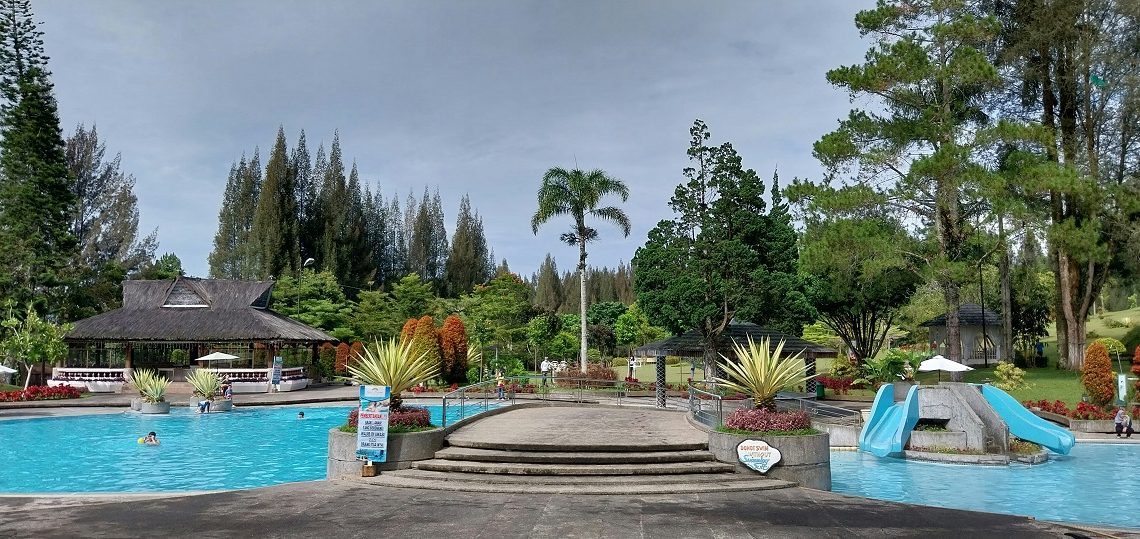
During the summer season, swimming pools are an important landmark for any tourist facility. Any water problems that result in temporary closure of the facility can turn into negative reviews that can seriously damage the reputation of the facility. It is therefore of paramount importance to prevent possible mishaps so as to ensure continuity in management.


Proper maintenance and constant monitoring are the essential elements to ensure perfect pool management. Maintenance should always be carried out by experienced personnel, who know how to deal with ordinary operations but also with extraordinary ones, due, for example, to an overload of users, rather than, what is unfortunately very common lately, an extreme weather situation.
There are not many steps to be taken, but they should be implemented steadily in ordinary situations and promptly in abnormal situations. This involves time. It is therefore essential, when planning staffing, to consider pool management as something to be given the proper attention and the correct number of man-hours, whether the management itself is done by in-house staff or contracted to an outside firm.


One mistake that is often made is to think that the lifeguard, in cases where he or she is present, can also take care of pool maintenance. Those who supervise the pool to avoid possible accidents should limit themselves to doing that, and doing it well if possible, without being distracted by other tasks. A lifeguard guarding bathers is not wasting time; he is performing an important task. To think that because he is there doing nothing, he can carry cribs, check chlorine, go to the engine room to perform a backwash, without thereby neglecting his supervisory duty, is profoundly wrong.
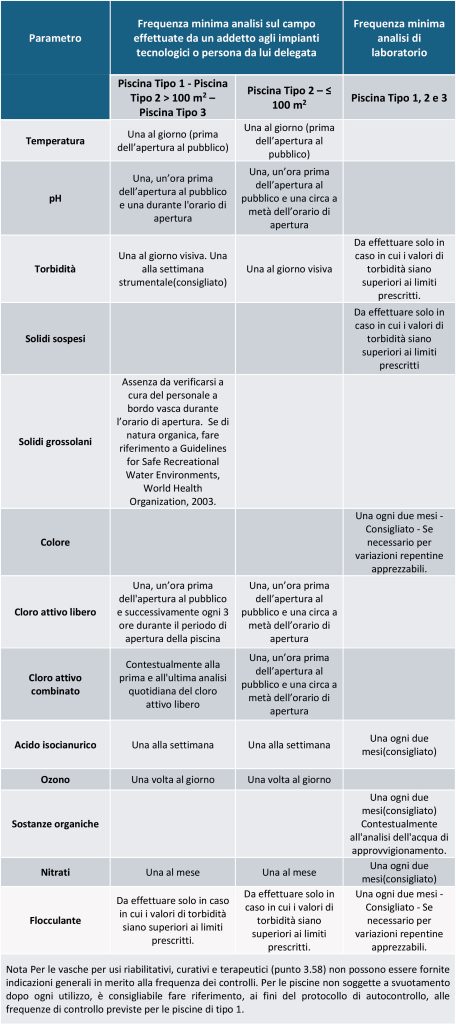
That said, let’s see what controls are required by laws and regulations, which are certainly essential to properly monitor swimming pool water. The controls to be carried out are those stipulated in Table A of the 2003 State-Regions Agreement, transposed by the regions and taken up in regional provisions where they exist, but still valid throughout the country(see previous article). The revision of UNI 10637, effective Feb. 8, 2024, slightly changed the frequency of mandatory inspections, which became those in the table below:
For bacteriological analyses under Table A, which must be carried out through an external laboratory, Standard UNI 10637:2024 provides:
- Type 1 pools: monthly frequency. If the analyses of 4 consecutive months have not detected deviations from the limits (Table A- 2013 Agreement), a reduction in frequency from monthly to bimonthly is allowed. If any of the subsequent bimonthly analyses detect noncompliance, the monthly frequency must be reinstated until an additional 4 consecutive compliant months are achieved.
- Type 2 and 3 pools: bimonthly frequency. If one of the bimonthly analyses detects noncompliance, monthly frequency should be introduced until at least 2 consecutive compliant months are achieved.
For all swimming pools, the first analysis must be conducted before the start of seasonal activity, and must be in compliance in order to open the facility to swimmers.
The frequency of analysis can be increased in case of technical inconveniences on facilities. In facilities and tanks in which there is equipment such as hydro/areo massage and/or other water/air intake systems that may give rise to aerosols, the legal protocol of legionellosis risk control must be applied. If the limits are exceeded, a verification procedure of the treatment plant must be implemented to identify and remove the causes of non-compliance, and concurrently, as soon as possible, the compliant conditions must be restored with subsequent control analysis to confirm the suitability of the water in the tank.
Swimming pools included in tourist-accommodation facilities have become Type 2 pools by Standard UNI 10637, bringing the terminology in line with current European standards. For the State-Regions Agreement and regional laws or resolutions, however, the classification remained as before. As can be seen from the tables, slightly different inspection frequencies have been introduced for Type 2 pools smaller than 100 square meters.
Standard UNI 10637:2024 also introduces an important aspect in Section 5.2.7.2.2: The frequency of analysis for Type2 pools equipped with automatic measuring and dosing systems, which are mandatory for pools built after 2015, can be changed at the self-inspection on the basis of reasoned arguments and analytical evidence. This clarification allows, for those who do not have the opportunity to check parameters in the field with the frequency required by the Standard, to reduce and/or modify them as part of self-control; this undoubtedly implies an assumption of responsibility on the part of the operator, but it allows justification for less frequent monitoring, based on serious and reasonable reasons such as, merely by way of example, remote monitoring.
© Riproduzione Riservata