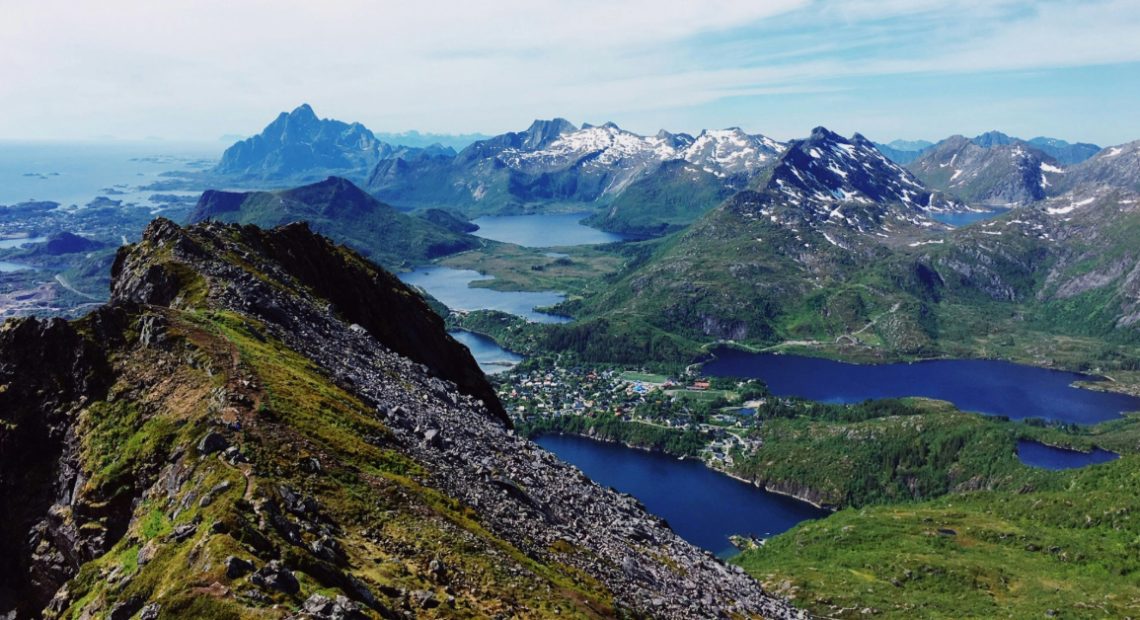
68°14′00″N, 14°34′00″E, polar coordinates for latitude but especially for our Mediterranean custom, yet the Lofoten archipelago, located northwest of the Norwegian coast, is characterized by a mild climate. Le islands that make it up are a mountain range formed over three billion years ago, whose wild peaks emerge from the waters of the Norwegian Sea, a spectacular orography that measures about 160 kilometers (100 miles).


Despite being about 200 km north of the Arctic Circle, temperatures are tempered by the Gulf Stream, and only during winter do they become “ice lands,” dark months during which the skies are illuminated with the emerald light of the Northern Lights. During the warm season, on the other hand, the sun never dips below the horizon giving very long, nightless days, the best time to fully experience all the activities this archipelago has to offer.
Austvågøy, Vestvågøy, Flakstadøy e Moskenesøy are the main islands, separated from the mainland by the Vestfjorden. It is easy to go from one to the other since they are all connected by bridges and tunnels, but you can also reach them by sea by paddling aboard a kayak just like a local, one of the best ways to take in the magnificent views around you from another perspective.


Lofoten is a real draw for outdoor activities, from biking to hiking, from horseback outings, to simple and beautiful walks along the roads and numerous trails, or from rorbu to rorbu, the typical red fishermen’s huts. It is also possible to ride along the E10, the scenic main road linking the five main islands, also known as the Lofast.
The Lofoten Islands are a perfect destination to practice sustainable tourism and stay in some camping facilities. An immersive vacation, in close contact with nature, but which does not preclude the opportunity to visit the most beautiful centers such as that of Svolvær, located on the southern coast of the island of Austvågøy, a delightful fishing village as well as a starting point for wonderful excursions, such as tours to Svolværgeita, the horn-shaped mountain known to climbers and trekkers. Also beautiful is Henningsvær, a short distance away, considered the most picturesque center in the archipelago, a nest of colorful wooden cottages framed by towering mountains.
Further north is another small gem of Lofoten, Reine. A landscape that seems to be painted with tiny colorful, predominantly red dwellings, a past and present linked to fishing, strictly for cod. An enchanted place watched over by Mount Reinebringen, a destination for memorable treks and picture-postcard views. This peak is famous for its enchanting scenic hikes, and for the many terraces with views from which you can also admire the Moskstraumen, a maelstrom also described by Jules Verne and Edgar Allan Poe, that is, a natural phenomenon created by strong tidal currents that transit a narrow, shallow stretch and generate eddies of water that can be up to 50 meters in diameter.
Camping in Lofoten
In the Lofoten Islands it is possible to stay in one of the many official campsites. The suggestion is always to choose one of these facilities using tent and RV sites: staying in the designated facilities and shopping locally promotes sustainable travel and helps local communities.
Alternatively, in the Lofoten Islands, free camping is possible in designated areas. In Norway, it is permissible to enjoy the great outdoors on non-agricultural land, provided you show respect for the landowner, other people, and flora and fauna.
In detail, it is good to consider the following points indicated by the local tourism office for responsible free camping:
- It is possible to park and stay overnight in roadside parking areas or on non-agricultural land.
- Remember to camp at least 150 meters away from any building.
- Avoid camping on private property or farmland and do not drive off-road.
- For road safety reasons, do not park in passing places on narrow roads.
- Show respect for your surroundings. The duty to travel without leaving tracks, damaging the land or disturbing wildlife always applies.
- Take your waste with you. Do not abandon waste during your travels. Dispose of waste in trash cans. Empty toilets and waste water at emptying stations.
- Signs prohibiting parking, camping, or staying overnight in RVs or caravans must be obeyed.
- Maintain a distance of at least four meters from other vehicles, etc. For fire safety reasons, park at least four meters away from other vehicles, etc.
© Riproduzione Riservata