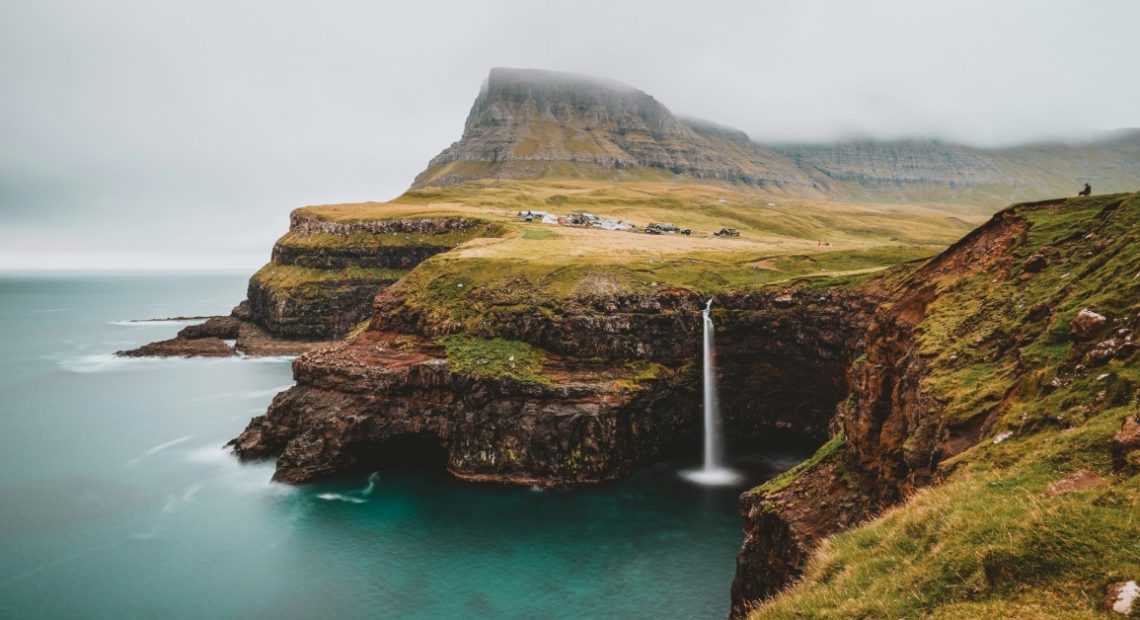
The Faroe Islands administratively belong to Denmark, and are located in the North Atlantic Ocean, midway between the Orkney Islands and Iceland. 18 pristine, wild islands shaped by volcanoes and glaciers, verdant and treeless, with high, rocky coastlines. Few landings from the sea and small towns turn them into adventure spaces where unspoiled nature reigns, but at the same time they prove to be a treasure chest of civilization rich in authentic traditions that have not changed over the centuries.

The Faroe archipelago is a true paradise for lovers of birdwatchers , especially the western part. The island of Mykines is the most popular destination, easily reached in 45 minutes by ferry from Vagar , the main island, home to the only airport. Here the Fratercula arctica, better known as the “ puffins,” have created a very large colony populating mainly the inaccessible reefs.
The avifauna of the Faroe Islands is dominated by seabirds but other species are also present: nearly 300 species have been recorded in the past 150 years. To admire and learn about them, there are several tours dedicated to birdwatching , by land or by sea, the latter excursions by boat close to the cliffs, the best way to admire the nests in the most inaccessible and spectacular ravines. The proposals along the trails are also a guaranteed spectacle as so many birds are attracted to the open spaces, and it is not uncommon to spot them among the flowering heathers and other low shrubs of the verdant moors.

The Faroe Islands are also a perfect destination for lovers of trekking , regardless of birdwatching activity. Throughout the archipelago it is possible to follow many paths, all of them different from each other. You’ll be spoiled for choice: trails weaving through small villages, or trails in the mountains, where you’ll encounter lonely farms that are chameleon-like thanks to the grass roof that camouflages the structure, and collect spectacular ocean views. Alternatively, you can start the excursion by boat, and continue by trekking along the cliffs from safe access points by sea.
In the summer season, there are countless opportunities to participate in excursions organized by experienced local guides. Highly recommended are the itineraries that explore the areas of Tórshavn e Kirkjubø . Also among the most beautiful destinations are the high cliffs of Djupini , in the beautiful area of Akraberg , where it is possible to reach the famous lighthouse located on the southernmost tip of the archipelago. Also suggestive are the routes that reach Lake Leitisvatn/Sørvágsvatn , and the waterfalls of Bøsdalafossur . Other exciting suggestions include a trip to theuninhabited islet of Lítla Dímun , or to theisland of Stóra Dímun , where a single family lives.
The Faroe Islands are also told in the most authentic traditions of a civilization that has always lived in close symbiosis with nature. Torshavn , one of the world’s smallest capitals, is well worth a visit. Among the most striking attractions is the picturesque neighborhood of Reyni , the old part of downtown, characterized by typical colorful wooden houses with grass roofs. Don’t be dissuaded by the size of the town: here you will find numerous small craft stores and restaurants offering typical dishes, prepared with the freshest and most local ingredients. There are many businesses that are committed to using zero-mile products and supporting sustainable agriculture and fishing. Savor the islands’ cuisine, mainly of lamb and freshly caught fish (but also the ever-present fermented fish), always accompanied by the ‘irreplaceable rye bread.
Camping in the Faroe Islands
There is no better way to explore the Faroe archipelago than by choosing an open-air stay, especially in the summertime when temperatures are milder. The archipelago is undoubtedly an ideal destination for those wishing to escape the hot Mediterranean summers: even in August, the mercury column hovers around ten degrees, and accompanying you will almost always be a thick, light drizzle.
If this is the climate you are looking for, imagine waking up to the sounds of nature, perhaps to the rhythm of ocean waves: a stay at a camping facility in the Faroe Islands is simply priceless, whether in a tent, bungalow or RV you will experience an unforgettable adventure.
Camping has become increasingly popular in recent years, and today there are more than 20 campsites available throughout the archipelago. Facilities can be found both within a stone’s throw of Torshavn, the capital, and on almost every island, including smaller ones such as Mykines, Kalsoy, and Fugloy.
It is important to remember that free camping is not allowed, and it is only possible to camp in designated areas, as there are no public wilderness or common areas in the Faroe Islands . In addition, it is not allowed to stay overnight in RVs along the roads, at rest stops, lay-bys or viewpoints.
Always pay attention even when booking the camping facility and consider that some campgrounds are designated only for tent camping, while others are exclusively for RVs.
© Riproduzione Riservata